
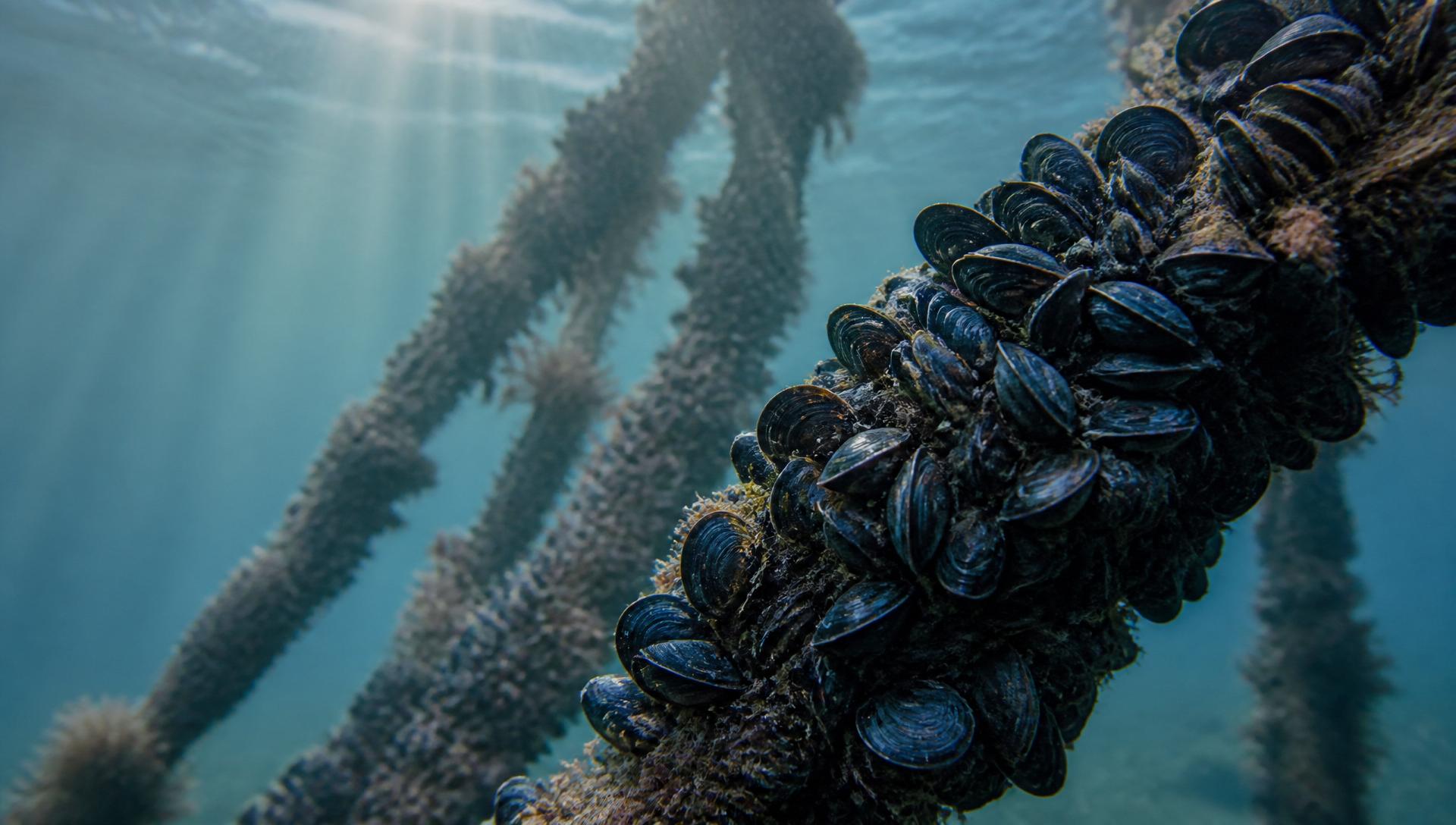
Could mussels be one of the most overlooked foods of our time?
Nutritious as red meat, low-carbon as beans, and farmed by simply putting ropes in the sea. Here's the 30-second version — then the deeper case.
Four reasons this small shellfish is worth a second look
Tap a card to jump straight to the section. Or keep scrolling for the full tour.
Dense in the nutrients hardest to get from plants
Iron, B12, long-chain omega-3 — closer to organ meat than to typical seafood.
Read more →Carbon in plant territory
Among the lowest-carbon animal proteins ever measured — beside beans and lentils.
Read more →A food that can clean the water it grows in
Filter feeders that remove the nutrients fuelling harmful algal blooms.
Read more →An animal — with a genuinely uncertain moral case
No brain, no central nervous system in the usual sense. Not obviously insensate.
Read more →A small animal with an unusually large nutritional profile
Mussels are dense in the nutrients that plant-based diets most often lack — and lower in saturated fat than most red meat.
| Food (100 g) | kcal | Protein (g) | Iron (mg) | B12 (µg) | Omega-3 (mg) |
|---|---|---|---|---|---|
| Mussels (cooked) | 172 | 24 | 6.7 | 24 | 700 |
| Beef (lean, cooked) | 250 | 26 | 2.9 | 2.6 | 60 |
| Pork (loin, cooked) | 242 | 27 | 1 | 0.7 | 50 |
| Chicken breast | 165 | 31 | 1 | 0.3 | 40 |
| Eggs (whole, cooked) | 155 | 13 | 1.8 | 1.1 | 100 |
| Tuna (yellowfin, cooked) | 130 | 29 | 0.8 | 2.4 | 240 |
| Salmon (Atlantic, cooked) | 208 | 22 | 0.4 | 3.2 | 2300 |
| Tofu (firm) | 144 | 17 | 2.7 | 0 | 500 |
| Soybeans (cooked) | 173 | 17 | 5.1 | 0 | 600 |
| Lentils (cooked) | 116 | 9 | 3.3 | 0 | 80 |
| Black beans (cooked) | 132 | 8.9 | 2.1 | 0 | 90 |
Approximate values per 100 g edible portion. Sources: USDA FoodData Central; Tan et al. (2021).[1] [2]
Iron and vitamin B12 are the two micronutrients most consistently under-consumed on strict plant-based diets. Long-chain omega-3 fatty acids (EPA and DHA) are found in meaningful amounts almost exclusively in marine animals.[1]
A 100 g portion of mussels supplies these three nutrients in amounts comparable to or exceeding beef, at roughly two-thirds of the calories.[2]
Carbon in plant territory
Because nothing has to be grown or fed to raise them, farmed mussels sit among the lowest-carbon animal proteins ever measured — in the same band as beans.
Greenhouse gas emissions per kilogram of food
kg CO₂e / kgEach bar is a plausible range across studies. Mussels sit in plant territory — the same band as beans and lentils, and roughly 30–100× below beef.
- Beef (beef herd)60–99
- Lamb20–39
- Cheese13–24
- Pork7–12
- Farmed salmon5–12
- Chicken6–10
- Eggs3.5–6
- Tofu2–3.5
- Beans & lentils0.4–2
- Mussels (rope-grown)0.3–2
Land-animal & plant figures: Poore & Nemecek (2018) via Our World in Data. Mussel figures from dedicated LCAs (blue mussel, Lyme Bay UK; NZ Greenshell; Scottish suspended culture). Boundaries differ between studies — read as orders of magnitude, not decimals. [3] [4] [5]
Dedicated life-cycle studies put rope-grown blue mussels at roughly 0.3–2 kg CO₂e per kg, depending on where you draw the boundary.[5]
Most of that tiny footprint is the harvesting boat itself. Even mussels shipped from Chile or New Zealand stay low-carbon — transport is usually a small slice of a food's total emissions. Locally grown is simply the lowest.
Roughly 5,700 km² of farmland — about the size of Skåne — could be freed each year if mussels replaced ~20% of Sweden's beef consumption. Because mussels need no cropland at all, every kilo that swaps in for a land-animal protein is a kilo's worth of feed crops, fresh water, and fertiliser we don't have to spend.[3] [10]
Uncertain Illustrative figure — based on Swedish per-capita beef consumption and typical beef land-use intensity.
Land use
m² / kg protein- Beef326
- Lamb185
- Cheese41
- Chicken12
- Tofu3.5
- Mussels0
Our World in Data (Poore & Nemecek).
Freshwater use
litres / kg product- Beef15,400
- Cheese5,600
- Chicken4,300
- Tofu2,200
- Mussels0
Mussel farming uses essentially no fresh water.
Feed conversion
kg feed / kg edible- Beef25
- Pork6
- Chicken3
- Salmon1.2
- Mussels0
Mussels feed on natural plankton.
Mussels are quietly some of the ocean's most useful animals
Before they are food, mussels are ecosystem engineers — organisms that measurably shape the environment they live in.
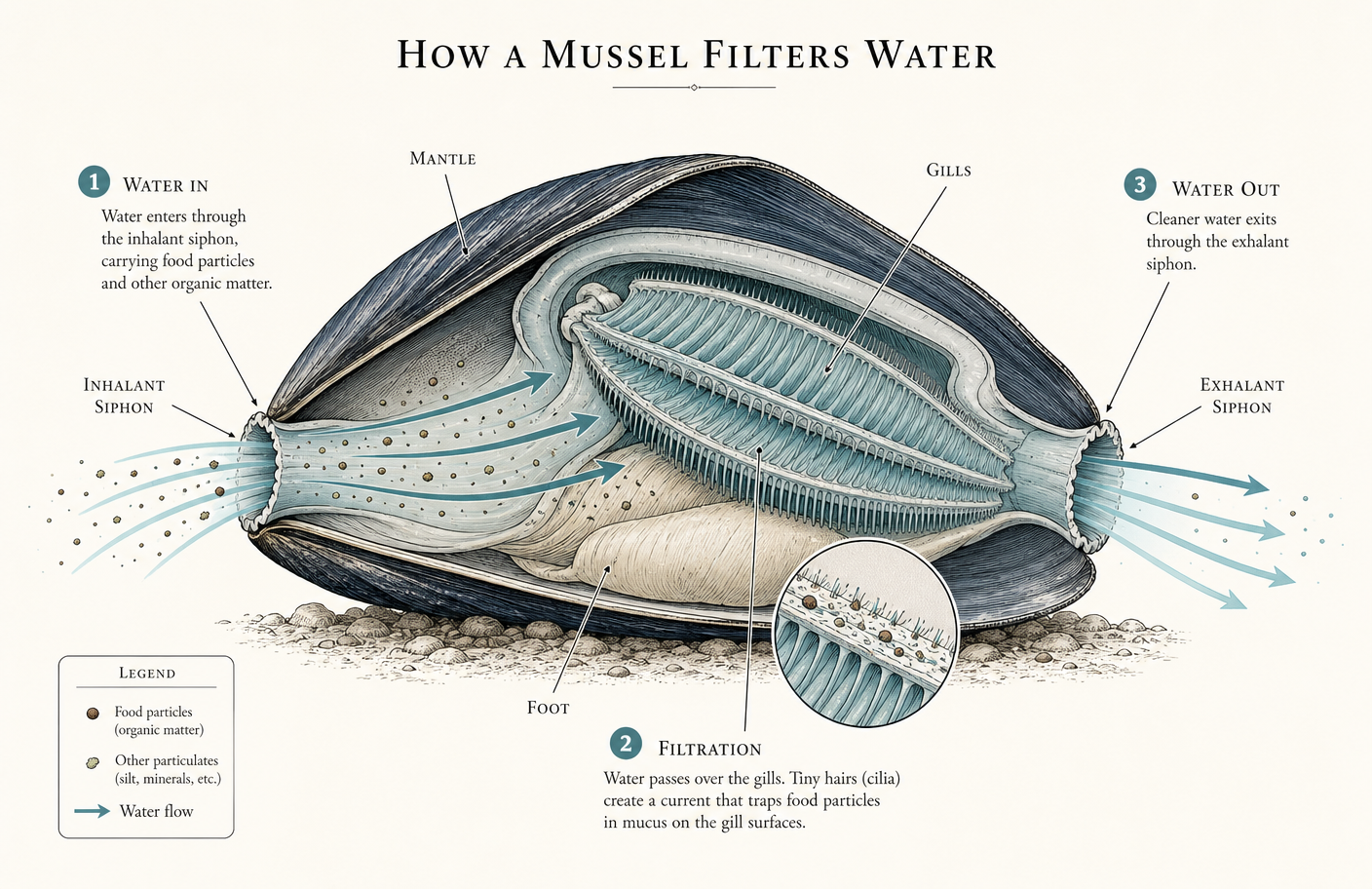
Almost every protein, plant or animal, adds to coastal pollution. Done well, mussels are the rare one that can subtract.
They eat what would otherwise become pollution
Mussels pull in seawater, strain out plankton and suspended particles, and release cleaner water. In eutrophic coastal zones this removes the exact nutrients that fuel harmful algal blooms.[6]
They move nutrients from sea to land
Harvesting mussels physically removes nitrogen and phosphorus from the water. In Denmark, mussel farms are used as a regulatory tool to offset agricultural runoff into the Baltic.[6]
Living reefs for other species
Mussel beds and cultivation ropes form dense three-dimensional structures that shelter juvenile fish, crustaceans, and invertebrates.[8]
Measurable effects on the water column
Large mussel populations can visibly increase water clarity, letting more light reach seagrass that in turn stabilises sediments and sequesters carbon.[7]
How do you farm an animal without feeding it?
Mussel farming is one of the strangest things in food production. Almost the entire process is: put ropes in the sea, wait.
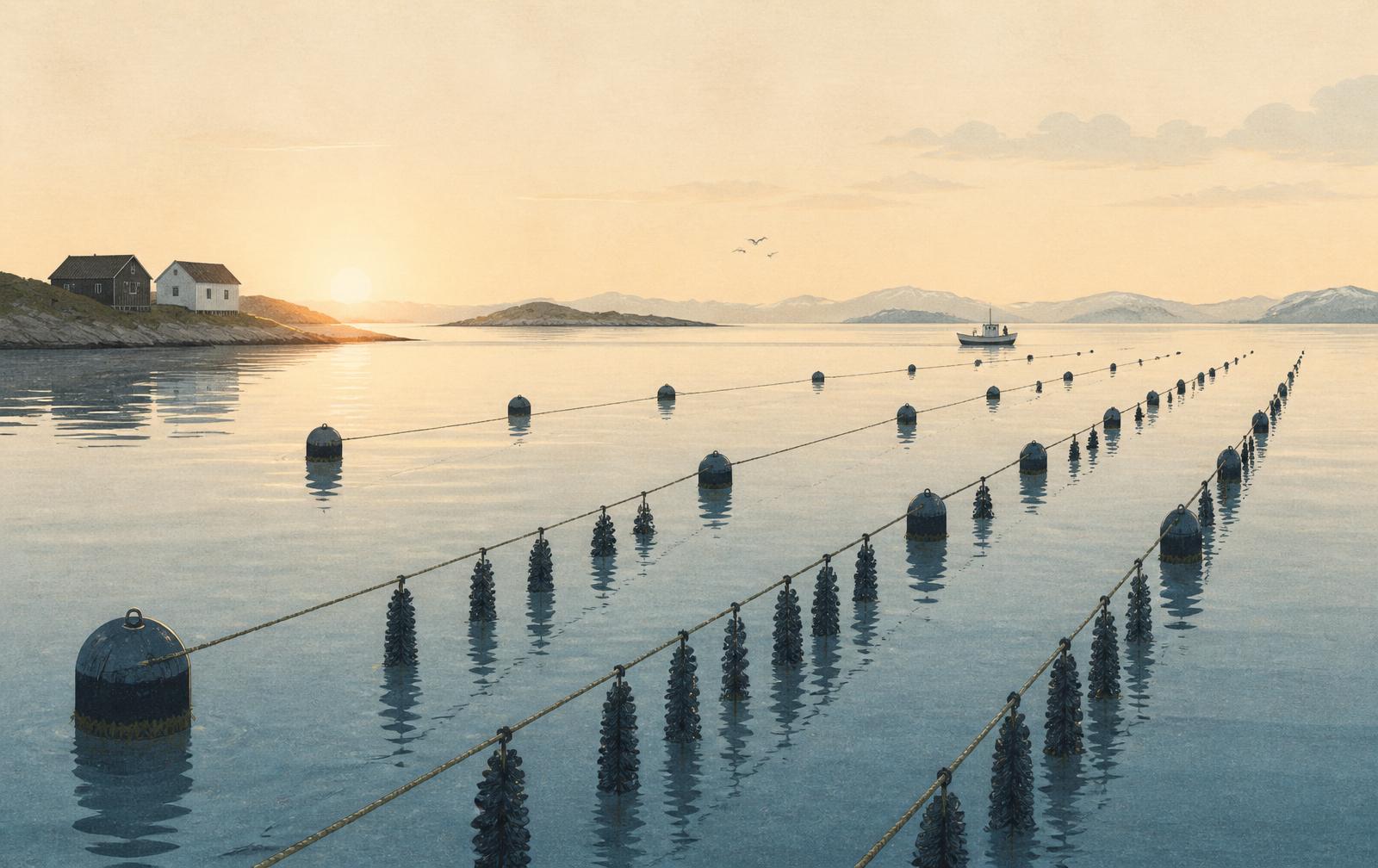
The process, in four steps
- 01Wild larvae attach
Ropes are lowered when mussel larvae are drifting in the water. They settle on the fibres naturally — no hatchery required.
- 02They grow on plankton
Over 12–24 months they feed exclusively on plankton already in the water. No feed, freshwater, fertiliser, or antibiotics.
- 03Ropes are harvested
Boats lift the ropes, strip the mussels, and return the ropes for the next cycle. Diesel is the main climate cost.
- 04Processing & sale
Mussels are cleaned, graded, and cooled. Packaging and refrigeration make up most of the remaining footprint.
- · High-density farms can locally deplete plankton.[9]
- · Shell fall and faeces can alter seabed conditions under ropes.
- · Escaped or introduced species can affect nearby ecology.
- · Plastic gear degrades over time and contributes to marine debris.
Are mussels "really" sustainable?
"Sustainable" is not a property of a species. It is a property of a system.
Whether a given mussel farm is a net-positive for its environment depends on where it is placed, how densely it is stocked, and how it is managed.[9]
A well-sited rope farm in a nutrient-loaded fjord can measurably improve water quality.[6] A poorly sited, overly dense farm in low-nutrient water can strip the water column and foul the seabed.
Nutrient-rich, well-flushed sites work with the ecosystem. Sheltered, nutrient-poor bays can be overwhelmed.
Every farm has a carrying capacity. Beyond it, the same practice that helps water quality can start to harm it.
Fallowing, monitoring, gear choice, and harvest scheduling change the outcome as much as the underlying biology.
Mussels are animals. What kind of moral consideration is that worth?
This is the question the rest of the project turns on. We do not answer it here.
Most people who eat plant-based do so because they believe animals can suffer. Mussels are difficult for this argument in both directions.
They are animals. They respond to their environment. They have a nervous system, and something that looks — under a microscope — like a stress response.[11] They are not obviously insensate in the way a mushroom is.
They also lack most of the anatomical features we tend to associate with consciousness: no brain, no central nervous system in the mammalian sense, no behaviour that suggests learning or preference.[12] Uncertain
The honest answer: the moral weight is probably small, and probably not zero. What follows from that is a question worth spending time on.
Bibliography
Every factual claim on this page is linked back here. We cite peer-reviewed papers, official reports, and recognised research organisations. Where a claim rests on interpretation or values, we say so with a certainty tag rather than a citation.
- [1]Tan, K., Ma, H., Li, S. & Zheng, H. (2021). Farmed mussels: a nutritive protein source, rich in omega-3 fatty acids, with a low environmental footprint. Foods, 10(4), 855 ↩
- [2]U.S. Department of Agriculture FoodData Central — nutrient profiles for mussels, beef, chicken, salmon, tofu, beans ↩
- [3]Poore, J. & Nemecek, T. (2018). Reducing food's environmental impacts through producers and consumers. Science, 360(6392), 987–992 ↩
- [4]Ritchie, H. & Roser, M. Environmental impacts of food production. Our World in Data ↩
- [5]Life-cycle assessments of blue mussel farming (Lyme Bay UK; NZ Greenshell; Scottish suspended culture) — typical range 0.3–2 kg CO₂e per kg product — Values vary with site, harvesting method, and system boundaries. ↩
- [6]Petersen, J. K. et al. (2019). Mussels as a tool for mitigation of nutrients in the marine environment. Marine Pollution Bulletin, 148, 145–155 ↩
- [7]Filgueira, R. et al. (2015). An integrated ecosystem approach for assessing the potential role of cultivated bivalve shells. ICES Journal of Marine Science, 72(7), 2043–2050 ↩
- [8]van der Schatte Olivier, A. et al. (2020). A global review of the ecosystem services provided by bivalve aquaculture. Reviews in Aquaculture, 12(1), 3–25 ↩
- [9]Ferreira, J. G. et al. (2007). Management of productivity, environmental effects and profitability of shellfish aquaculture. Aquaculture, 262(1), 1–16 ↩
- [10]Ritchie, H. Land use per diet. Our World in Data ↩
- [11]Fiorito, G. (1986). Is there pain in invertebrates?. Behavioural Processes, 12(4), 383–388 ↩
- [12]Tomasik, B. Can bivalves suffer?. Reducing Suffering ↩