
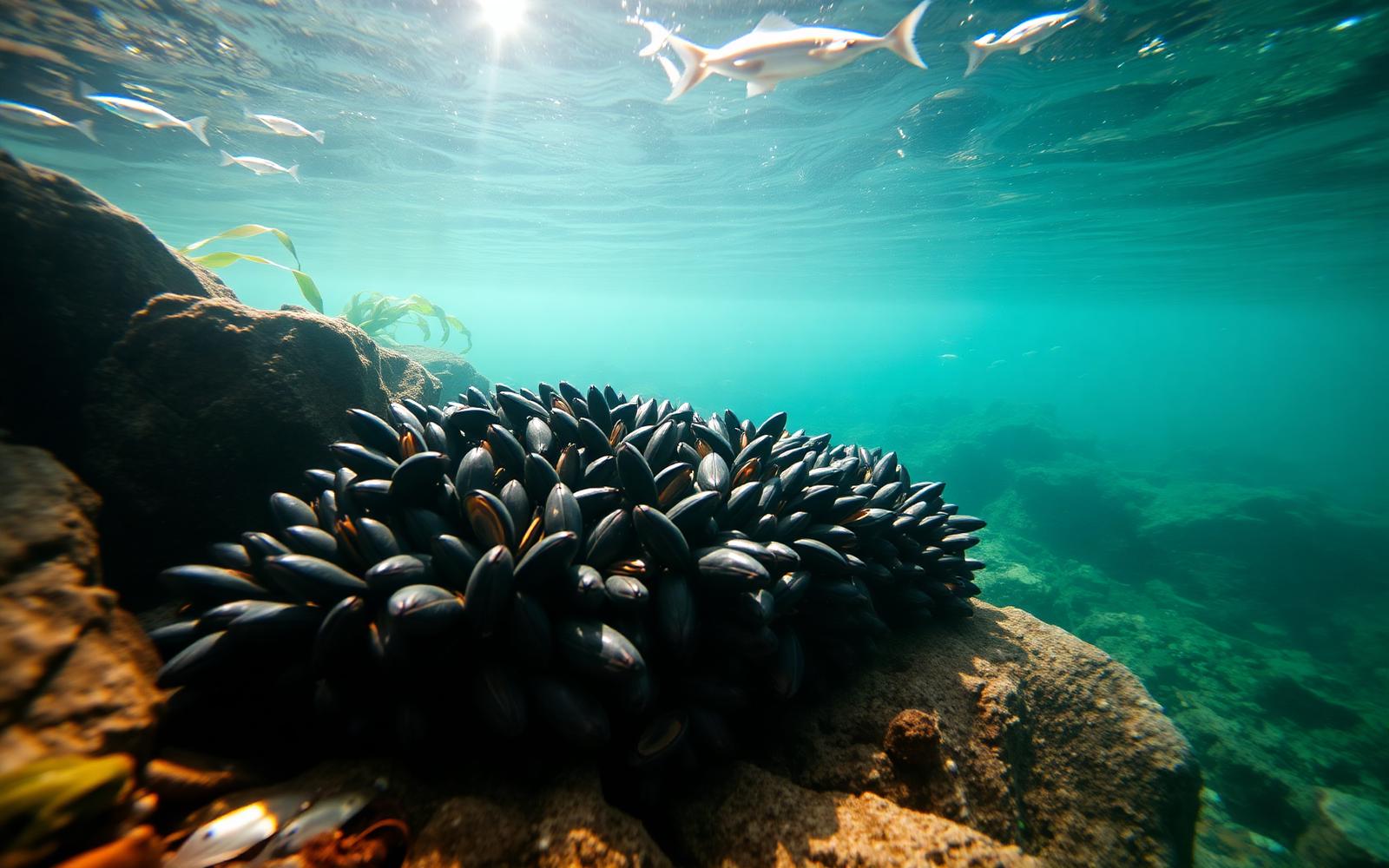
The hidden biology of one of the ocean's most important animals.
A mussel looks like a stone with a hinge. It is, in fact, an animal — a filter feeder, an ecosystem engineer, and the product of hundreds of millions of years of evolution. This page is a short tour of what mussels are, how they live, and why scientists find them quietly fascinating.
An animal you can pick up in one hand — a filter feeder with a nervous system, a life that starts adrift in open water, and an outsized effect on the coast it lives on.
Pick a chapter, or read straight through
Each chapter is a short stop on the same page. Tap one to jump.
Anatomy
Shell, gills, byssus — how a mussel is built.
Read chapter →Life
Filter feeding, spawning, and a life that starts in open water.
Read chapter →Nervous system
Three ganglia, no brain — and what that means.
Read chapter →Ecology
Ecosystem engineers that quietly build habitat.
Read chapter →Farming
No feed, no freshwater — but real limits.
Read chapter →Climate
Warming and acidification, and shells under strain.
Read chapter →What is a mussel?
Enough context to make the rest of the page make sense — no more.
Mussels are bivalve mollusks: soft-bodied animals inside a two-part hinged shell. They sit on the same branch of the tree of life as oysters, clams and scallops.[1]
They are animals, not plants. They have a shell of calcium carbonate, soft tissue with gills and a digestive tract, and a simple nervous system (much more on that below). They feed by pulling seawater through their gills and extracting the microscopic life suspended in it. Established
Understanding how a mussel is built leads to a simpler question — how does it live?
How does a mussel live?
Two things a mussel spends its life doing: filtering water for food, and reproducing into the same water.
A pump that eats plankton.
A mussel draws water in through one siphon, passes it across a fine mesh of ciliated gills, catches particles in a mucus layer, and sweeps the trapped food to its mouth. Cleaner water leaves through the other siphon.[2]
What they eat: phytoplankton (single-celled algae), tiny detritus, and other suspended organic particles. What they don't eat: anything that requires chasing, chewing, or catching.
A life that starts in open water.
Mussels reproduce by broadcast spawning: adults release millions of eggs and sperm into the water, where fertilisation happens externally. The resulting larva drifts as plankton for weeks before settling onto a hard surface, growing shell, and starting the adult life it will keep for years.[3]
- Stage 1EggsReleased into open water and fertilised externally.
- Stage 2LarvaeDrift as plankton for 3–4 weeks.
- Stage 3SettlementAnchor to a hard surface with byssal threads.
- Stage 4AdultFilters water, grows, and spawns — often for decades.
Fig. 3 — A typical blue mussel life cycle. Timing depends on species and water temperature.
Understanding how a mussel functions internally leads to another fascinating question — how does it perceive its environment?
A very different way of sensing the world.
Mussels are animals with nervous systems. Their nervous systems are also nothing like ours.
Unlike humans and other vertebrates, mussels do not have a brain. Instead, they have a decentralised nervous system — several small clusters of neurons called ganglia, wired together by thin nerve cords running through the body.[13][15]
A mussel isn't blind to its world. Through sensors spread across its body it picks up four broad categories of information:
Mechanical contact along the mantle edge triggers rapid valve closure.
Dissolved cues from prey, predators, and neighbours are picked up by chemoreceptors.
Salinity, temperature, and oxygen levels are sensed and acted on.
Chemical alarm signals from crushed neighbours cause fast defensive closure.
A nervous system, at its most basic, is a way for an organism to process information and respond to what's around it. Mussels do this well enough to feed, defend themselves, and time their spawning to the season.[16]
But whether any of this gives rise to subjective experience — whether there is something it is like to be a mussel — is a separate question, and one of the most fascinating unanswered questions in biology and philosophy.
Whether this gives rise to subjective experience remains one of the most fascinating unanswered questions in biology and philosophy.
If simply responding to the environment were enough to conclude that an organism is conscious, we would have to ask similar questions about plants — which respond to light and touch — or even non-living systems like a thermostat, which detects and responds to temperature. The existence of a response, on its own, cannot settle the question of experience.
Structure matters too: a mussel's ganglia are not organised like a vertebrate brain. And the reverse holds — the absence of a familiar brain does not, on its own, prove that nothing is going on inside.
Somewhere along this line, "just responding" becomes "experiencing." Nobody knows exactly where — and it may not be a line at all.
Understanding the biology is only the beginning. What this nervous system tells us about conscious experience is explored on the Philosophy page.
Mussels are ecosystem engineers.
They don't just live in an ecosystem. They quietly build one.
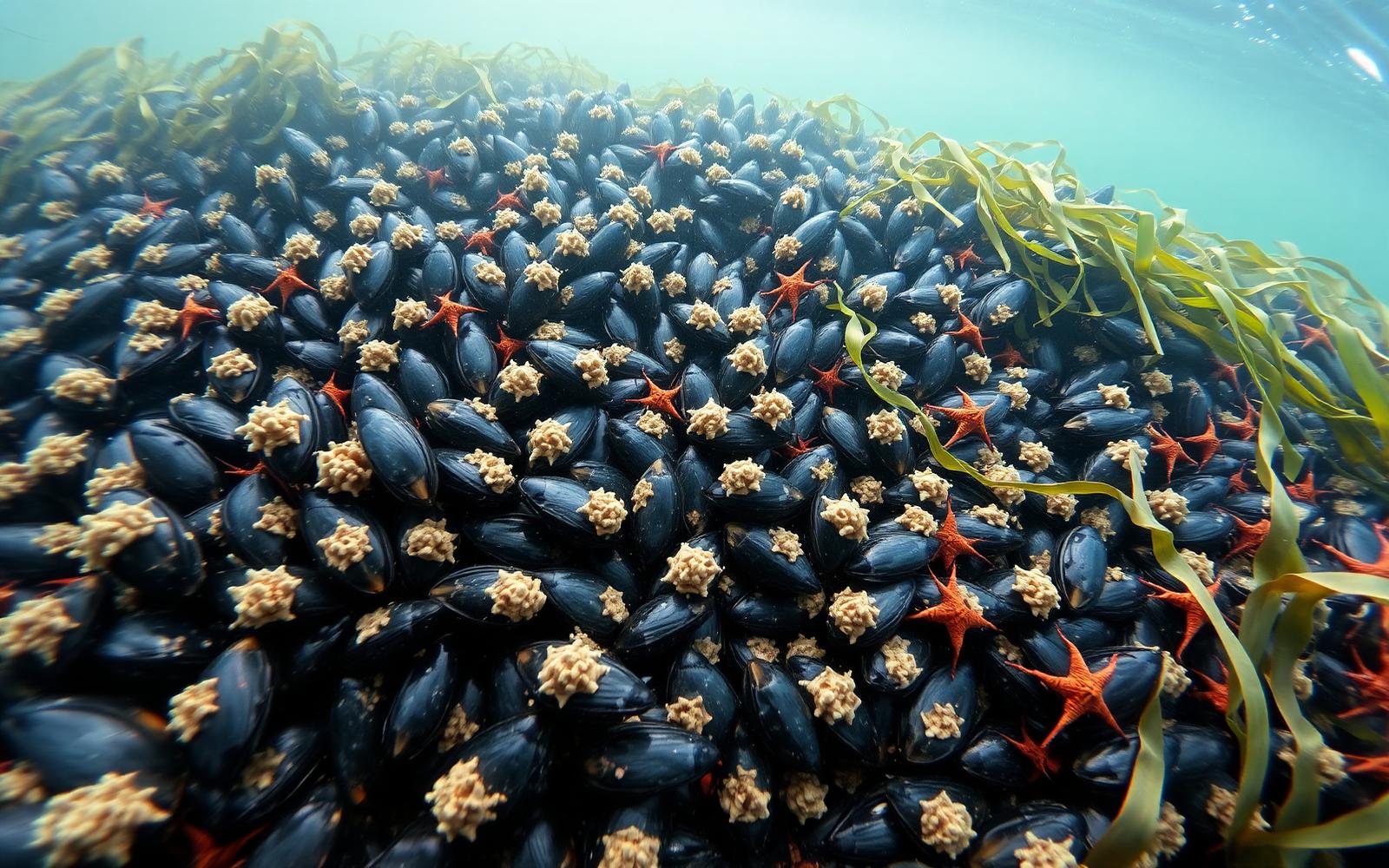
They clarify the water.
A dense mussel bed can process the volume of its own bay every few days, pulling particles and excess algae out of suspension.[5]
They move nutrients around.
Mussels take up nitrogen and phosphorus with their food and either build them into tissue or drop them onto the seabed as packaged waste — moving nutrients from open water to benthos.
They build homes for others.
The three-dimensional structure of a mussel bed shelters starfish, small crabs, worms, juvenile fish, and countless microorganisms.[4]
The chain, in one line
Removing mussels can cause major losses of habitat complexity and associated species. This is why ecologists describe them as foundation species.
An animal that quietly rebuilds its surroundings raises a practical question — can we grow them at scale without breaking what makes them useful?
How mussels are farmed — and why it's unusual.
No feed, no freshwater, no cropland. But 'low-input' is not the same as 'free of impact'.
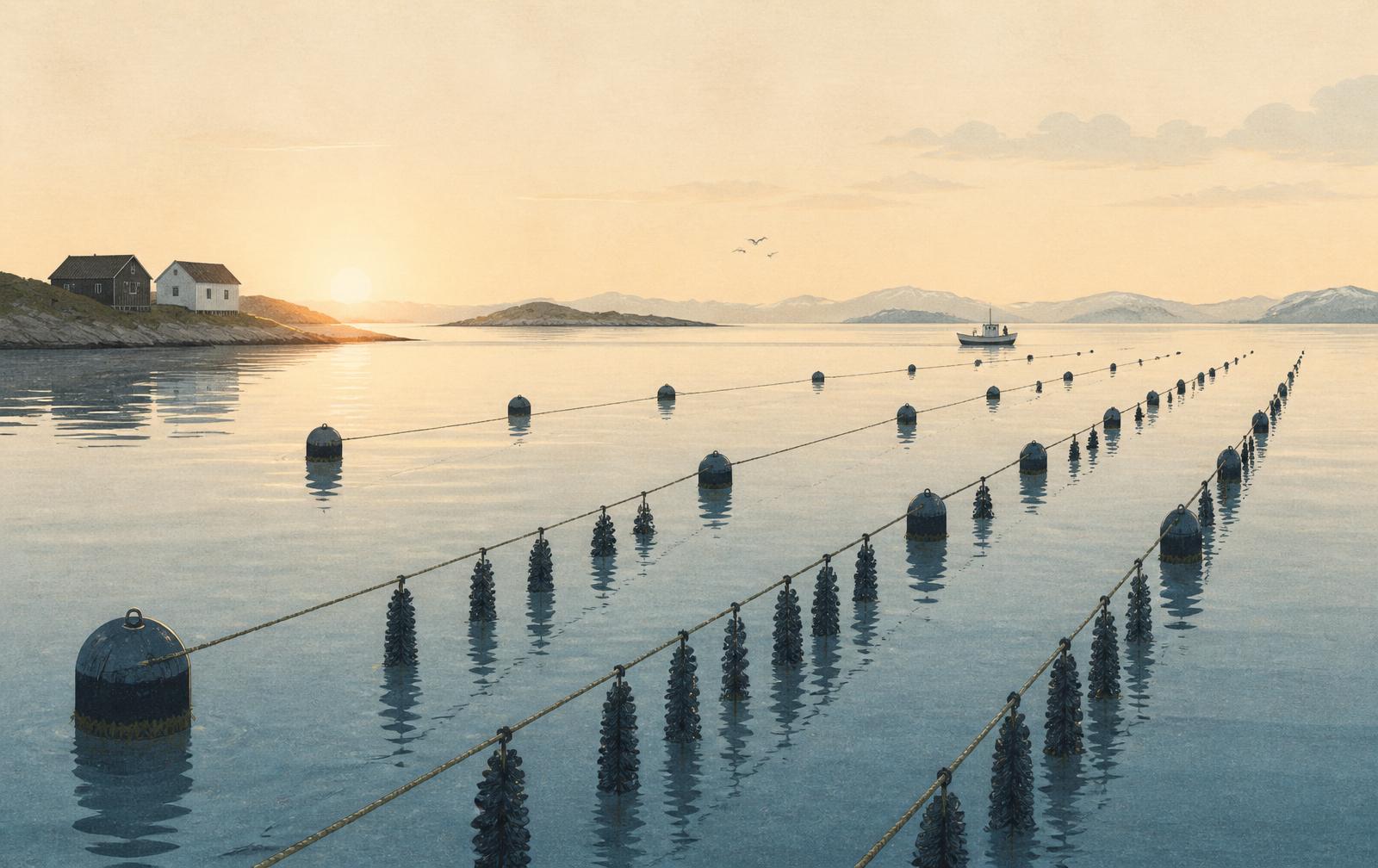
Four common methods
Rope culture
Ropes hang vertically from surface floats; mussels attach and grow along their length. Most common in Europe.
Longlines
Horizontal lines held near the surface by buoys, with ropes dropped every few metres. Common offshore.
Rafts
Wooden or plastic rafts anchored in bays, with ropes hanging beneath. Widely used in Galicia (Spain).
Bottom culture
Seed mussels sown directly onto seabed plots. Traditional in the Wadden Sea and northeast US.
- • No manufactured feed — mussels eat wild plankton.
- • No freshwater use.
- • No farmland required.
- • No antibiotics or hormones.
- • Can improve local water quality when well-sited.[5]
- • Every bay has a carrying capacity for plankton removal.
- • Waste under dense farms can foul the seabed.
- • Local biodiversity effects depend on siting.
- • Diseases and heatwaves can wipe out stocks.
- • Global expansion potential is real but not unlimited.[6]
Interpretation Mussel farming looks unusually good on the axes we normally worry about with animal agriculture. Whether it is good in this bay, at this density is an empirical question that has to be answered locally.
However well-farmed, mussels don't live in a stable ocean any more. The water itself is changing.
Mussels in a warmer, more acidic ocean.
The same CO₂ that warms the atmosphere is quietly reshaping the water mussels build their shells from.
Growth, timing, and range.
Warmer water can speed early growth, but also shifts spawning timing, stresses adults during marine heatwaves, and pushes populations poleward — sometimes past the reach of the ecosystems that depend on them.[9]
Current research The exact magnitude of these effects varies by species, region, and life stage — this is an active area of research, not a solved problem.
Filters remember what the sea contains.
Mussels accumulate what's in their water. That makes them useful science — and requires careful management.
Because a mussel pumps tens of litres of water across its gills every day, traces of what is in that water end up briefly inside the mussel. Scientists actually exploit this: mussels are used as sentinel organisms in coastal pollution monitoring programmes worldwide, precisely because they concentrate what is there to measure.[10]
Heavy metals
Absorbed from local runoff and sediment; monitored routinely in commercial areas.
Microplastics
Detected in mussels, but most are excreted within days; mussel exposure is small vs. bottled water or indoor air.[11]
Algal biotoxins
Produced by harmful algal blooms; harvesting is paused when levels exceed thresholds.[12]
Established Commercial mussels are grown in classified waters and tested for biotoxins and pathogens before harvest. Accumulation does not automatically mean unsafe food — it means the food safety system exists for a reason, and works.
What scientists still don't know.
Science is not finished. Some of the most interesting mussel questions are still open.
- Q1How will mussel populations respond to the combined pressures of warming and acidification over the coming decades?
- Q2How can aquaculture expand without exceeding local ecological carrying capacity?
- Q3What ecological roles do mussel beds play that we haven't yet measured?
- Q4What are the actual limits of bivalve sensory experience — and how would we ever know?
Understanding biology is the first step. The next question is philosophical: what does it mean for an animal to experience the world?
Continue to Philosophy →Bibliography
Every factual claim on this page is linked back here. We cite peer-reviewed papers, official reports, and recognised research organisations. Where a claim rests on interpretation or values, we say so with a certainty tag rather than a citation.
- [1]Gosling, E. (2015). Marine Bivalve Molluscs (2nd ed.). Wiley-Blackwell — standard reference on bivalve biology, anatomy, and life history ↩
- [2]Riisgård, H. U. et al. (2014). Filter feeding, particle retention and clearance rates in Mytilus edulis. Journal of Sea Research ↩
- [3]Bayne, B. L. (2017). Biology of Oysters. Academic Press — comparative bivalve reproduction and larval ecology ↩
- [4]Kotta, J. et al. (2020). Mussel beds as biodiversity hotspots and habitat engineers. Marine Ecology Progress Series ↩
- [5]Lindahl, O. et al. (2005). Improving marine water quality by mussel farming — a profitable measure for Swedish society. AMBIO 34(2) ↩
- [6]Gentry, R. R. et al. (2017). Mapping the global potential for marine aquaculture. Nature Ecology & Evolution ↩
- [7]Pernet, F. & Browman, H. I. (2025). Bivalve farming is not a CO₂ sink. Reviews in Aquaculture ↩
- [8]Gazeau, F. et al. (2013). Impacts of ocean acidification on marine shelled molluscs. Marine Biology 160 ↩
- [9]IPCC (2019). Special Report on the Ocean and Cryosphere in a Changing Climate — Chapter 5 (Changing Ocean, Ecosystems, Communities) ↩
- [10]Beyer, J. et al. (2017). Blue mussels (Mytilus edulis spp.) as sentinel organisms in coastal pollution monitoring: a review. Marine Environmental Research 130 ↩
- [11]Henry, B. et al. (2025). Microplastics in seafood, in context. Environmental Science & Technology Letters ↩
- [12]EFSA Panel on Biological Hazards (2010). Scientific opinion on marine biotoxins in shellfish — summary. EFSA Journal 8(8) ↩
- [13]Wollesen, T. et al. (2022). The evolution of nervous system centralization in molluscs. Philosophical Transactions of the Royal Society B ↩
- [14]Crump, A. et al. (2022). Sentience in decapod crustaceans: a general framework and review of the evidence. Animal Sentience — framework used across invertebrate sentience research ↩
- [15]Bullock, T. H. & Horridge, G. A. (1965). Structure and Function in the Nervous Systems of Invertebrates. W. H. Freeman — foundational comparative reference on invertebrate nervous systems ↩
- [16]Mackie, G. O. (1984). Bivalves — review of neurobiology and sensory systems. In: Neurobiology of Molluscan Model Systems ↩
- [17]Gazeau, F. et al. (2007). Impact of elevated CO₂ on shellfish calcification. Geophysical Research Letters, 34(7) ↩